Showing posts with label Laurindo Almeida. Show all posts

Tuesday, February 3, 2026

Tommy Tedesco • The Guitars Of Tom Tedesco


Tommy Tedesco Biography
Billed as "the most recorded guitarist in history," Tommy Tedesco was certainly one of the top session guitarists of all time, able to play convincingly in virtually every style of music, but concentrating on pop/rock, jazz, and soundtrack work. Tedesco was born July 3, 1930, in Niagara Falls, NY; after moving to Los Angeles, he carved out a career as one of the area's most in-demand session musicians, appearing on his first recording in the late '50s. Tedesco's notable associations during the '60s included the Beach Boys, Jan & Dean, Phil Spector, Van Dyke Parks, the 5th Dimension, the Monkees, and Elvis Presley. He also did some of his most acclaimed work in 1968 on Frank Zappa's Lumpy Gravy; according to legend, Tedesco and some of the other session men caught wind of Zappa's freaky reputation, and showed up for the session dressed in wacky costumes, not realizing Zappa's music would turn out to be too complicated for them to play the first time through.

In the '70s, Tedesco appeared on Partridge Family recordings and also worked with Herb Alpert, adding to his list of more traditional pop and jazz credits which already included work with Frank Sinatra, Ella Fitzgerald, Barbra Streisand, and Sarah Vaughan. With the advent of the fusion era, jazz became Tedesco's primary focus for a time; he began leading his own combo and (finally) releasing albums under his own name, beginning with 1978's Autumn and When Do We Start. Alone at Last followed in 1979, as did the quintet album My Desiree in 1981. Two more albums appeared in 1983: the live trio set Carnival Time, and Thomas and Ocean Tedesco. However, they essentially marked the end of Tedesco's flurry of activity as a leader; the 1986 trio album Hollywood Gypsy would be his last for several years.

From the outset of his career, Tedesco also worked extensively in the film and television industries. He lent his guitar to the opening theme songs of shows like The Mickey Mouse Club, The Ozzie & Harriet Show, The Twilight Zone, Bonanza, Green Acres, Gilligan's Island, The Munsters, Happy Days, M*A*S*H*, and Dallas, among others. As for his film work, just some of his credits include the soundtracks toCool Hand Luke, The French Connection, The Exorcist, The Deer Hunter, The Godfather, Jaws, E.T., Blade Runner, and Field of Dreams.

In addition to his recorded work, Tedesco gave guitar lessons and clinics around the country, and authored several instructional books; he also wrote a regular column in Guitar Player magazine. In 1992, he returned to solo work with the albums Fine Fretted Friend and the symphonic Tommy Tedesco Performs Roumanis' Jazz Rhapsody. However, that same year, he also suffered a stroke. Within a year, Tedesco rebounded to write an autobiography, -Confessions of a Guitar Player, which was filled with behind-the-scenes details of various sessions he had been involved in. Tedesco was able to continue his teaching activities for a time, even after he was diagnosed with lung cancer not too long afterwards. On November 10, 1997, Tedesco succumbed to the disease at his home in Northridge, CA, at the age of 67. ~ Steve Huey, All Music Guide

Thomas J. Tedesco (July 3, 1930 – November 10, 1997) was an American  master session musician and renowned jazz and bebop guitarist.

Tedesco's credits, to name a few, include the themes to television's Bonanza, The Twilight Zone, Green Acres, M*A*S*H, Batman, and Elvis Presley's '68 Comeback Special. He was shown on-camera for a number of game and comedy shows, and played ex-con guitarist Tommy Marinucci, a member of Happy Kyne's Mirth-Makers, in the talk-show spoof Fernwood 2 Night.

Born in Niagara Falls, New York, Tedesco made his way to the U.S. West Coast where he became one of the most-sought-after studio guitarists between the 1960s and 1980s. Although Tedesco was primarily a guitar player, he was also qualified on the mandolin, ukulele, and the sitar as well as 28 other stringed instruments (though he played all of them in guitar tuning).

Tedesco was described by Guitar Player magazine as the most recorded guitarist in history, having played on thousands of recordings. He recorded with most of the top musicians working in the Los Angeles area including The Beach Boys, The Mamas & the Papas, the Everly Brothers, The Association, Barbra Streisand, Elvis Presley, Ella Fitzgerald, Frank Zappa, Sam Cooke, Cher, and Nancy and Frank Sinatra. For Guitar Player, Tedesco wrote a regular column called "Studio Log" in which he would describe a day's work recording a movie, TV show or album, the special challenges each job posed and how he solved them, what instruments he used, and how much money he made on the job.

Tedesco also performed for film soundtracks such as The French Connection, The Godfather, Jaws, The Deer Hunter, Field of Dreams, plus several Elvis Presley films. He was also the guitarist for the Original Roxy cast of The Rocky Horror Show. Additionally, he performed the opening guitar solo for the Howard Hawkes & John Wayne film Rio Lobo. He was one of the very few sidemen credited for work on animated cartoons for the The Ant and the Aardvark cartoons (1968-1971).

On his own, Tedesco recorded a number of jazz guitar albums but his musical career ended in 1992 when he suffered a stroke that resulted in partial paralysis. The following year he published his autobiography titled "Confessions of a Guitar Player".

Tommy Tedesco died in Northridge, California in 1997, aged 67, from lung cancer

Tedesco, along with many of his fellow studio musicians, was featured in the 95-minute 2008 film The Wrecking Crew by his son, Denny Tedesco. The film has screened at several festivals, but has not yet been commercially released.


Monday, April 7, 2025

The L.A. Four • Live at Montreux


Biography by Scott Yanow
Altoist/flutist Bud Shank and Brazilian acoustic guitarist Laurindo Almeida first teamed up in the 1950s to create music that predated but strongly hinted at bossa nova. In 1974, they reunited to form the L.A. Four with bassist Ray Brown and drummer Chuck Flores. With Shelly Manne and later Jeff Hamilton replacing Flores on drums, the L.A. Four recorded eight albums for Concord through 1982, breaking up shortly afterward. Their mixture of cool-toned bop, Brazilian-oriented music, and ballads was quite attractive.
https://www.allmusic.com/artist/the-la-4-mn0000090637#biography

///////


Biografía de Scott Yanow
El alto flautista Bud Shank y el guitarrista acústico brasileño Laurindo Almeida se unieron por primera vez en la década de 1950 para crear una música anterior a la bossa nova, aunque con fuertes guiños a ésta. En 1974, se reunieron para formar los L.A. Four con el bajista Ray Brown y el batería Chuck Flores. Con Shelly Manne y más tarde Jeff Hamilton sustituyendo a Flores en la batería, los L.A. Four grabaron ocho álbumes para Concord hasta 1982, separándose poco después. Su mezcla de bop fresco, música brasileña y baladas era bastante atractiva.
https://www.allmusic.com/artist/the-la-4-mn0000090637#biography  


Thursday, February 6, 2025

Laurindo Almeida • This Can't Be Love


Laurindo Almeida was born on September 2, 1917, Sao Paulo, Brazil, A fluent and skilled musician, famous in his native country as a classical Spanish guitar player, Almeida came to the USA in the 40s to work in film and television studios(he composed music for over 800 movies & TV series and recorded numerous LPs and CDs).

His jazz work was first widely exposed during a spell with Stan Kenton in the late 40s. Although continuing his film and television work, Almeida also took many opportunities to play jazz, joining forces with bassist Harry Babasin, altoist Bud Shank and drummer Roy Harte in 1953.

The work of this group anticipated many of the hallmarks of the bossa nova craze which came a few years later. In 1974 Almeida gained further appreciation when he was teamed with bassist Ray Brown, drummer Chuck Flores and Shank to form the La Four. Records by this group, with Flores replaced successively by Shelly Manne and Jeff Hamilton, and later teamings with Shank in duo performances and with fellow guitarists Larry Coryell and Charlie Byrd, show Almeida to have lost none of the distinctive style that sets his work apart from the mainstream of jazz guitar.

His career has been celebrated by winning among others grammy awards in 1959 for his performance on Danzas, in 1960 for The Spanish Guitars Of Laurindo Almeida and Conversations With The Guitar. The following year he gained two more with Discantos and Reverie For Spanish Guitars and in 1962 further honours with nominations with Viva Bossa Nova! in the Best Performance By An Orchestra For Dancing and Best Jazz Performance categories and a third nomination with The Intimate Bach (Best Classical performance).

In 1964 the album Guitar From Ipanema won the grammy for Best Instrumental Jazz Performance, in 1972 he was nominated for the Best Soloist award with The Art Of Laurindo Almeida. He died July 26th 1995 in Van Nuys, California, USA.
https://www.allaboutjazz.com/musicians/laurindo-almeida/

///////


Laurindo Almeida nació el 2 de septiembre de 1917, Sao Paulo, Brasil, músico fluido y hábil, famoso en su país natal como guitarrista clásico español, Almeida llegó a los EE.UU. en los años 40 para trabajar en estudios de cine y televisión(compuso música para más de 800 películas y series de televisión y grabó numerosos LP y CD).

Su trabajo de jazz fue ampliamente expuesto por primera vez durante un período con Stan Kenton a fines de los años 40. Aunque continuó con su trabajo en cine y televisión, Almeida también aprovechó muchas oportunidades para tocar jazz, uniendo fuerzas con el bajista Harry Babasin, el altoista Bud Shank y el baterista Roy Harte en 1953.

El trabajo de este grupo anticipó muchas de las características distintivas de la locura de la bossa nova que se produjo unos años más tarde. En 1974, Almeida ganó mayor aprecio cuando se asoció con el bajista Ray Brown, el baterista Chuck Flores y Shank para formar The La Four. Los discos de este grupo, con Flores reemplazado sucesivamente por Shelly Manne y Jeff Hamilton, y más tarde formando equipo con Shank en actuaciones a dúo y con sus compañeros guitarristas Larry Coryell y Charlie Byrd, muestran que Almeida no ha perdido nada del estilo distintivo que distingue su trabajo de la corriente principal de la guitarra de jazz.

Su carrera ha sido celebrada ganando entre otros premios Grammy en 1959 por su interpretación en Danzas, en 1960 por Las Guitarras Españolas de Laurindo Almeida y Conversaciones con La Guitarra. Al año siguiente ganó dos más con Discantos y Reverie Para Guitarras Españolas y en 1962 ¡más honores con nominaciones con Viva Bossa Nova! en las categorías de Mejor Interpretación de Orquesta Para Baile y Mejor Interpretación de Jazz y una tercera nominación con El Bach Íntimo (Mejor Interpretación Clásica).

En 1964 el álbum Guitar From Ipanema ganó el grammy a la Mejor Interpretación Instrumental de Jazz, en 1972 fue nominado al premio al Mejor Solista con El Arte de Laurindo Almeida. Murió el 26 de julio de 1995 en Van Nuys, California, EE. UU.
https://www.allaboutjazz.com/musicians/laurindo-almeida/


Monday, January 27, 2025

Tuesday, January 21, 2025

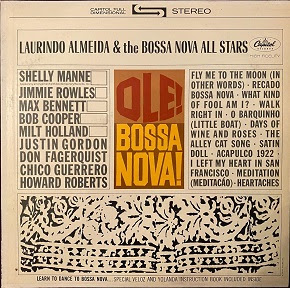
Laurindo Almeida • Ole! Bossa Nova


Biography by arwulf arwulf
During a long and uncommonly productive career, Brazilian guitarist Laurindo Almeida achieved a ubiquity in popular music that has yet to be fully recognized. Largely responsible for the Brazilian/North American "samba jazz" that would eventually catch on in the form of a musical trend known as bossa nova, he played behind dozens of well-known pop vocalists and improved the overall texture of many a studio production ensemble. One credible estimate states that Almeida contributed to no less than 800 film soundtracks (among them The Old Man and the Sea, How the West Was Won, and Breakfast at Tiffany's), as well as countless TV scores. He also authored a series of guitar instruction books that are still in use worldwide. A master improviser and a skilled arranger as well as a brilliant interpreter of classical repertoire, he left for posterity superb recordings of works by J.S. Bach, Fryderyk Chopin, Claude Debussy, and Joaquín Rodrigo as well as a host of Brazilian composers including Heitor Villa-Lobos, Radamés Gnattali, and Alfredo Vianna. Almeida's own chamber compositions include a concerto for guitar and orchestra.

Laurindo Jose de Araujo Almeida Nobrega Neto was born in the village of Prainha near the Port of Santos in the state of São Paulo, Brazil, on September 2, 1917. He received his first musical instruction from his mother, a classically trained pianist, and credited her fondness for the music of Fryderyk Chopin as a primary influence. After observing his sister being given guitar lessons, "Lindo" borrowed her instrument and retreated to a barn where he taught himself to play entirely by ear, transferring what he'd heard his mother play on the piano to the strings of the guitar. Many years later he would declare his preference for the direct intimacy of the guitar as opposed to the more percussive piano. By the age of nine he had become uncommonly skilled and was well on the way to becoming a guitar virtuoso; it was then that he lost his father to typhoid fever. At 12 he relocated to São Paulo with his brother. He joined the Revolutionary Army at 15 and was wounded in a civil conflagration. While recuperating in a hospital he met Garoto, a nationally respected guitarist who was visiting to perform for the patients. Within a few years, Almeida would perform and record extensively with Garoto.

In 1935 Almeida moved to Rio de Janeiro, where he teamed up with singer and tenor guitarist Nestor Amaral and began working in radio while becoming active as a songwriter, arranger, and multi-instrumentalist and performing regularly at the Casino da Urea. He composed folk songs, fox trots, sambas, choros, waltzes, and comedic airs, and worked with a broad range of artists including choro master Pixinguinha. He also collected 78-rpm jazz records, and was especially fond of the way Fats Waller played the piano. In 1936, at the age of 19, he got a job (playing banjo for the most part so as to be heard) for half a year on the Cuyaba, a cruise ship that docked in every country along the coast of Europe from Spain to Germany. While visiting Paris he was able to hear Django Reinhardt and Stéphane Grappelli in person. In 1941 he played the Casino Copacabana, and switched over to the Casino Balneario da Urca the following year. It was there that he met a Portuguese ballerina named Natalia (Maria Miguelina Ferreira Ribeiro) in 1944 and married her shortly afterwards.

After touring north with Carmen Miranda, Laurindo Almeida moved to Los Angeles in 1947, and was able to do so because of royalties received from the sale of his tune "Johnny Pedlar," made famous as "Johnny Peddler" by popular acts like Jimmy Dorsey, Les Brown, and the Andrews Sisters. He performed in Laguna Beach with Nestor Amaral, José Oliveira, and violinist Elisabeth Waldo and appeared in a variety show with vocalist Dennis Day and comedians Victor Borge and Red Skelton, and in movies with Jimmy Durante and Danny Kaye. What made Almeida so different from anyone else on the scene at the time was his practice of using only his fingers on the guitar strings; everybody else used picks. When asked who his favorite guitarists were, he gave an answer that was emblematic of his entire career: classical virtuoso Andrés Segovia and Oscar Moore of the King Cole Trio. Almeida's film production work brought him to the attention of bandleader Stan Kenton, who hired and featured him while absorbing stylistic elements of the northeast Brazilian baiao, the samba, and the choro. Kenton eventually composed "Lament" especially for the guitarist. Almeida's direct involvement with Kenton's orchestra lasted until 1952. His first album as a solo artist, Concert Creations for Guitar, was released in 1950 by Kenton's host label, Capitol.

Just as Machito, Dizzy Gillespie, and Chano Pozo had enlivened the scene with their Afro-Cuban jazz during the late '40s, Laurindo Almeida's session work during his first decade in the U.S. pollinated the modern jazz scene with rhythms and melodies from Brazil. During the years 1953-1958, he recorded several jazz samba albums with saxophonist Bud Shank that have since come to be regarded as precursors of the bossa nova trend of the late '50s and early '60s. In addition to steady session work with vocalists like June Christy, Rosemary Clooney, Nat King Cole, Bing Crosby, Doris Day, Frankie Laine, Peggy Lee, Robert Mitchum, Connie Russell, Frank Sinatra, Martha Tilton, Mel Tormé, Kitty White, and vocal groups like the Four Freshmen, the Hi-Lo's, and the Platters, Almeida collaborated with bandleader Ray Anthony, pianist George Shearing, multi-instrumentalist Herbie Mann, space age pop music's Juan Garcia Esquivel, Kenton's right-hand man Pete Rugolo, and Hollywood's master of movie music Henry Mancini.

Between 1960 and 1967 Almeida put out no less than nine pop-oriented albums for Capitol; these were in addition to at least as many "classical" titles for that label. When the bossa nova craze really set in, Almeida brought an authentic Brazilian presence to records by Stan Getz, Shorty Rogers, and Cal Tjader; he also assisted with a Harry Belafonte Christmas LP and cut an album with the Modern Jazz Quartet, touring with them throughout all of Europe. While continuing to work with Mancini, he practiced anonymity as a member of Guitars Unlimited and the 50 Guitars of Tommy Garrett, sat in with bandleader Gerald Wilson, backed Dean Martin and Sammy Davis, Jr., and shared a session with trumpeter Rafael Méndez. In 1968 he played on the soundtrack of the film Charly, based upon Flowers for Algernon, a novel by Daniel Keyes.

In 1970 Almeida was one of the musicians backing Phil Ochs on his Greatest Hits album, produced by Van Dyke Parks, who invited the guitarist back to record the album Discover America in 1972. In 1974 Almeida and Bud Shank formed the L.A. 4 with bassist Ray Brown and drummer Shelly Manne (later replaced by Jeff Hamilton); this unit would eventually turn out at least eight albums, mostly for the Concord label, with which Almeida would be closely associated for the rest of his days. During the 1980s he performed with his second wife, Canadian soprano Deltra Ruth Eamon; he also recorded several albums with guitarist Charlie Byrd and led a trio at Disney World in Orlando, FL. In 1988 he formed a three-piece unit called Guitarjam with Sharon Isbin and Larry Coryell. Laurindo Almeida never failed to get behind musicians who earned his respect, and was especially supportive of other guitarists, including fellow Brazilian Baden Powell and classicist Paulo Bellinati. At the age of 74 he cut a live album (Outra Vez) with his trio at a club near San Diego, performing (in addition to his own compositions) works by Antonio Carlos Jobim, Enriqué Granados, Thelonious Monk, Ludwig van Beethoven, Irving Berlin, and Antonin Dvorák. This intriguingly diverse selection was typical of Laurindo Almeida, who passed away on July 26, 1995, in Van Nuys, CA.
https://www.allmusic.com/artist/laurindo-almeida-mn0000761478#biography

///////

Biografía de arwulf arwulf
Durante una carrera larga y extraordinariamente productiva, el guitarrista brasileño Laurindo Almeida logró una ubicuidad en la música popular que aún no ha sido plenamente reconocida. En gran parte responsable del "samba jazz" brasileño/norteamericano que eventualmente se popularizaría en la forma de una tendencia musical conocida como bossa nova, tocó detrás de docenas de conocidos vocalistas pop y mejoró la textura general de muchos conjuntos de producción de estudio. Una estimación creíble afirma que Almeida contribuyó a no menos de 800 bandas sonoras de películas (entre ellas The Old Man and the Sea, How the West Was Won y Breakfast at Tiffany's), así como a innumerables bandas sonoras de televisión. También es autor de una serie de libros de instrucciones de guitarra que todavía se usan en todo el mundo. Maestro improvisador y hábil arreglista, así como brillante intérprete de repertorio clásico, dejó para la posteridad magníficas grabaciones de obras de J. S. Bach, Fryderyk Chopin, Claude Debussy y Joaquín Rodrigo, así como una gran cantidad de compositores brasileños, incluidos Heitor Villa-Lobos, Radamés Gnattali y Alfredo Vianna. Las composiciones de cámara de Almeida incluyen un concierto para guitarra y orquesta.

Laurindo José de Araujo Almeida Nobrega Neto nació en el pueblo de Prainha, cerca del puerto de Santos, en el estado de São Paulo, Brasil, el 2 de septiembre de 1917. Recibió su primera instrucción musical de su madre, una pianista de formación clásica, y atribuyó su afición por la música de Fryderyk Chopin como influencia principal. Después de observar a su hermana recibiendo lecciones de guitarra, "Lindo" tomó prestado su instrumento y se retiró a un granero donde aprendió a tocar completamente de oído, transfiriendo lo que había escuchado tocar a su madre en el piano a las cuerdas de la guitarra. Muchos años después declararía su preferencia por la intimidad directa de la guitarra frente al piano más percusivo. A la edad de nueve años se había vuelto extraordinariamente hábil y estaba en camino de convertirse en un virtuoso de la guitarra; fue entonces cuando perdió a su padre a causa de la fiebre tifoidea. A los 12 años se mudó a São Paulo con su hermano. Se unió al Ejército Revolucionario a los 15 años y resultó herido en una conflagración civil. Mientras se recuperaba en un hospital conoció a Garoto, un guitarrista respetado a nivel nacional que estaba de visita para tocar para los pacientes. En pocos años, Almeida actuaría y grabaría extensamente con Garoto.

En 1935 Almeida se mudó a Río de Janeiro, donde se asoció con el cantante y guitarrista tenor Nestor Amaral y comenzó a trabajar en la radio mientras se volvía activo como compositor, arreglista y multiinstrumentista y actuaba regularmente en el Casino da Urea. Compuso canciones folclóricas, fox trots, sambas, choros, valses y aires cómicos, y trabajó con una amplia gama de artistas, incluido el maestro del choro Pixinguinha. También coleccionaba discos de jazz de 78 rpm, y le gustaba especialmente la forma en que Fats Waller tocaba el piano. En 1936, a la edad de 19 años, consiguió un trabajo (tocando el banjo en su mayor parte para ser escuchado) durante medio año en el Cuyaba, un crucero que atracaba en todos los países de la costa de Europa, desde España hasta Alemania. Mientras visitaba París, pudo escuchar a Django Reinhardt y Stéphane Grappelli en persona. En 1941 tocó en el Casino Copacabana, y se cambió al Casino Balneario da Urca al año siguiente. Fue allí donde conoció a una bailarina portuguesa llamada Natalia (Maria Miguelina Ferreira Ribeiro) en 1944 y se casó con ella poco después.

Después de hacer una gira por el norte con Carmen Miranda, Laurindo Almeida se mudó a Los Ángeles en 1947 y pudo hacerlo gracias a las regalías recibidas por la venta de su canción "Johnny Pedlar", que se hizo famosa como "Johnny Peddler" por actos populares como Jimmy Dorsey, Les Brown y the Andrews Sisters. Actuó en Laguna Beach con Nestor Amaral, José Oliveira y la violinista Elisabeth Waldo y apareció en un programa de variedades con el vocalista Dennis Day y los comediantes Victor Borge y Red Skelton, y en películas con Jimmy Durante y Danny Kaye. Lo que hizo a Almeida tan diferente de cualquier otra persona en la escena en ese momento fue su práctica de usar solo sus dedos en las cuerdas de la guitarra; todos los demás usaban púas. Cuando se le preguntó quiénes eran sus guitarristas favoritos, dio una respuesta emblemática de toda su carrera: el virtuoso clásico Andrés Segovia y Oscar Moore del Trío King Cole. El trabajo de producción cinematográfica de Almeida llamó la atención del líder de la banda Stan Kenton, quien lo contrató y presentó mientras absorbía elementos estilísticos del baiao del noreste de Brasil, la samba y el choro. Kenton eventualmente compuso "Lament" especialmente para el guitarrista. La participación directa de Almeida con la orquesta de Kenton duró hasta 1952. Su primer álbum como solista, Concert Creations for Guitar, fue lanzado en 1950 por el sello anfitrión de Kenton, Capitol.

Así como Machito, Dizzy Gillespie y Chano Pozo animaron la escena con su jazz afrocubano a fines de los 40, el trabajo de sesión de Laurindo Almeida durante su primera década en los EE.UU. polinizó la escena del jazz moderno con ritmos y melodías de Brasil. Durante los años 1953-1958, grabó varios álbumes de jazz samba con el saxofonista Bud Shank que desde entonces se han considerado precursores de la tendencia bossa nova de finales de los 50 y principios de los 60. Además de trabajar en sesiones constantes con vocalistas como June Christy, Rosemary Clooney, Nat King Cole, Bing Crosby, Doris Day, Frankie Laine, Peggy Lee, Robert Mitchum, Connie Russell, Frank Sinatra, Martha Tilton, Mel Tormé, Kitty White y grupos vocales como The Four Freshmen, The Hi-Lo's y the Platters, Almeida colaboró con el líder de la banda Ray Anthony, el pianista George Shearing, el multiinstrumentista Herbie Mann, Juan García Esquivel de space age pop Music, Pete Rugolo, mano derecha de Kenton, y Henry Mancini, maestro de la música cinematográfica de Hollywood.

Entre 1960 y 1967 Almeida lanzó no menos de nueve álbumes orientados al pop para Capitol; estos se sumaron al menos a otros tantos títulos "clásicos" para ese sello. Cuando realmente comenzó la locura de la bossa nova, Almeida trajo una auténtica presencia brasileña a los discos de Stan Getz, Shorty Rogers y Cal Tjader; también ayudó con un LP Navideño de Harry Belafonte y grabó un álbum con el Cuarteto de Jazz Moderno, girando con ellos por toda Europa. Mientras continuaba trabajando con Mancini, practicó el anonimato como miembro de Guitars Unlimited y the 50 Guitars of Tommy Garrett, se sentó con el líder de la banda Gerald Wilson, respaldó a Dean Martin y Sammy Davis, Jr., y compartió una sesión con el trompetista Rafael Méndez. En 1968 participó en la banda sonora de la película Charly, basada en Flowers for Algernon, una novela de Daniel Keyes.

En 1970 Almeida fue uno de los músicos que respaldó a Phil Ochs en su álbum de Grandes éxitos, producido por Van Dyke Parks, quien invitó al guitarrista a volver a grabar el álbum Discover America en 1972. En 1974 Almeida y Bud Shank formaron The L. A. 4 con el bajista Ray Brown y la baterista Shelly Manne (luego reemplazada por Jeff Hamilton); esta unidad eventualmente produciría al menos ocho álbumes, la mayoría para el sello Concord, con el que Almeida estaría estrechamente asociado durante el resto de sus días. Durante la década de 1980 actuó con su segunda esposa, la soprano canadiense Deltra Ruth Eamon; también grabó varios álbumes con el guitarrista Charlie Byrd y dirigió un trío en Disney World en Orlando, Florida. En 1988 formó una unidad de tres piezas llamada Guitarjam con Sharon Isbin y Larry Coryell. Laurindo Almeida nunca dejó de apoyar a músicos que se ganaron su respeto, y apoyó especialmente a otros guitarristas, incluidos su compatriota brasileño Baden Powell y el clasicista Paulo Bellinati. A los 74 años grabó un álbum en vivo (Outra Vez) con su trío en un club cerca de San Diego, interpretando (además de sus propias composiciones) obras de Antonio Carlos Jobim, Enriqué Granados, Thelonious Monk, Ludwig van Beethoven, Irving Berlin y Antonin Dvorák. Esta selección intrigantemente diversa fue típica de Laurindo Almeida, quien falleció el 26 de julio de 1995 en Van Nuys, California.
https://www.allmusic.com/artist/laurindo-almeida-mn0000761478#biography


Tuesday, December 3, 2024

L.A. 4 • Watch What Happens


Biography by Scott Yanow
Altoist/flutist Bud Shank and Brazilian acoustic guitarist Laurindo Almeida first teamed up in the 1950s to create music that predated but strongly hinted at bossa nova. In 1974, they reunited to form the L.A. Four with bassist Ray Brown and drummer Chuck Flores. With Shelly Manne and later Jeff Hamilton replacing Flores on drums, the L.A. Four recorded eight albums for Concord through 1982, breaking up shortly afterward. Their mixture of cool-toned bop, Brazilian-oriented music, and ballads was quite attractive.
https://www.allmusic.com/artist/the-la-4-mn0000090637#biography

///////


Biografía de Scott Yanow
El alto flautista Bud Shank y el guitarrista acústico brasileño Laurindo Almeida se unieron por primera vez en la década de 1950 para crear una música anterior a la bossa nova, aunque con fuertes guiños a ésta. En 1974, se reunieron para formar los L.A. Four con el bajista Ray Brown y el batería Chuck Flores. Con Shelly Manne y más tarde Jeff Hamilton sustituyendo a Flores en la batería, los L.A. Four grabaron ocho álbumes para Concord hasta 1982, separándose poco después. Su mezcla de bop fresco, música brasileña y baladas era bastante atractiva.
https://www.allmusic.com/artist/the-la-4-mn0000090637#biography  


Tuesday, August 20, 2024

The L.A. Four • Just Friends


Review by Scott Yanow
On this rewarding set, the L.A. Four (altoist Bud Shank, acoustic guitarist Laurindo Almeida, bassist Ray Brown, and drummer Jeff Hamilton) perform a Bach melody, "Carinhoso" (originally recorded by Shank and Almeida back in 1954), "Just Friends," a "Love" medley ("Love for Sale" and "Love Walked In"), and Chick Corea's "Spain." Shank sticks exclusively to alto for the date, leaving his flute in its case, and the result is a more high-powered program than usual. Recommended. https://www.allmusic.com/album/just-friends-mw0000690297

///////


Crítica de Scott Yanow
En este gratificante set, los L.A. Four (el contralto Bud Shank, el guitarrista acústico Laurindo Almeida, el bajista Ray Brown y el batería Jeff Hamilton) interpretan una melodía de Bach, «Carinhoso» (grabada originalmente por Shank y Almeida en 1954), «Just Friends», un popurrí de «Love» («Love for Sale» y «Love Walked In») y «Spain» de Chick Corea. Shank se ciñe exclusivamente al contralto para la cita, dejando la flauta en su estuche, y el resultado es un programa más potente de lo habitual. Recomendable. https://www.allmusic.com/album/just-friends-mw0000690297


Saturday, August 10, 2024

The L.A. Four • Going Home


Biography by Scott Yanow
Altoist/flutist Bud Shank and Brazilian acoustic guitarist Laurindo Almeida first teamed up in the 1950s to create music that predated but strongly hinted at bossa nova. In 1974, they reunited to form the L.A. Four with bassist Ray Brown and drummer Chuck Flores. With Shelly Manne and later Jeff Hamilton replacing Flores on drums, the L.A. Four recorded eight albums for Concord through 1982, breaking up shortly afterward. Their mixture of cool-toned bop, Brazilian-oriented music, and ballads was quite attractive.
https://www.allmusic.com/artist/the-la-4-mn0000090637#biography

///////


Biografía de Scott Yanow
El alto flautista Bud Shank y el guitarrista acústico brasileño Laurindo Almeida se unieron por primera vez en la década de 1950 para crear una música anterior a la bossa nova, aunque con fuertes guiños a ésta. En 1974, se reunieron para formar los L.A. Four con el bajista Ray Brown y el batería Chuck Flores. Con Shelly Manne y más tarde Jeff Hamilton sustituyendo a Flores en la batería, los L.A. Four grabaron ocho álbumes para Concord hasta 1982, separándose poco después. Su mezcla de bop fresco, música brasileña y baladas era bastante atractiva.
https://www.allmusic.com/artist/the-la-4-mn0000090637#biography  


Thursday, June 6, 2024

Laurindo Almeida Quartet Featuring Bud Shank • Idem


Biography by arwulf arwulf
During a long and uncommonly productive career, Brazilian guitarist Laurindo Almeida achieved a ubiquity in popular music that has yet to be fully recognized. Largely responsible for the Brazilian/North American "samba jazz" that would eventually catch on in the form of a musical trend known as bossa nova, he played behind dozens of well-known pop vocalists and improved the overall texture of many a studio production ensemble. One credible estimate states that Almeida contributed to no less than 800 film soundtracks (among them The Old Man and the Sea, How the West Was Won, and Breakfast at Tiffany's), as well as countless TV scores. He also authored a series of guitar instruction books that are still in use worldwide. A master improviser and a skilled arranger as well as a brilliant interpreter of classical repertoire, he left for posterity superb recordings of works by J.S. Bach, Fryderyk Chopin, Claude Debussy, and Joaquín Rodrigo as well as a host of Brazilian composers including Heitor Villa-Lobos, Radamés Gnattali, and Alfredo Vianna. Almeida's own chamber compositions include a concerto for guitar and orchestra.

Laurindo Jose de Araujo Almeida Nobrega Neto was born in the village of Prainha near the Port of Santos in the state of São Paulo, Brazil, on September 2, 1917. He received his first musical instruction from his mother, a classically trained pianist, and credited her fondness for the music of Fryderyk Chopin as a primary influence. After observing his sister being given guitar lessons, "Lindo" borrowed her instrument and retreated to a barn where he taught himself to play entirely by ear, transferring what he'd heard his mother play on the piano to the strings of the guitar. Many years later he would declare his preference for the direct intimacy of the guitar as opposed to the more percussive piano. By the age of nine he had become uncommonly skilled and was well on the way to becoming a guitar virtuoso; it was then that he lost his father to typhoid fever. At 12 he relocated to São Paulo with his brother. He joined the Revolutionary Army at 15 and was wounded in a civil conflagration. While recuperating in a hospital he met Garoto, a nationally respected guitarist who was visiting to perform for the patients. Within a few years, Almeida would perform and record extensively with Garoto.

In 1935 Almeida moved to Rio de Janeiro, where he teamed up with singer and tenor guitarist Nestor Amaral and began working in radio while becoming active as a songwriter, arranger, and multi-instrumentalist and performing regularly at the Casino da Urea. He composed folk songs, fox trots, sambas, choros, waltzes, and comedic airs, and worked with a broad range of artists including choro master Pixinguinha. He also collected 78-rpm jazz records, and was especially fond of the way Fats Waller played the piano. In 1936, at the age of 19, he got a job (playing banjo for the most part so as to be heard) for half a year on the Cuyaba, a cruise ship that docked in every country along the coast of Europe from Spain to Germany. While visiting Paris he was able to hear Django Reinhardt and Stéphane Grappelli in person. In 1941 he played the Casino Copacabana, and switched over to the Casino Balneario da Urca the following year. It was there that he met a Portuguese ballerina named Natalia (Maria Miguelina Ferreira Ribeiro) in 1944 and married her shortly afterwards.

After touring north with Carmen Miranda, Laurindo Almeida moved to Los Angeles in 1947, and was able to do so because of royalties received from the sale of his tune "Johnny Pedlar," made famous as "Johnny Peddler" by popular acts like Jimmy Dorsey, Les Brown, and the Andrews Sisters. He performed in Laguna Beach with Nestor Amaral, José Oliveira, and violinist Elisabeth Waldo and appeared in a variety show with vocalist Dennis Day and comedians Victor Borge and Red Skelton, and in movies with Jimmy Durante and Danny Kaye. What made Almeida so different from anyone else on the scene at the time was his practice of using only his fingers on the guitar strings; everybody else used picks. When asked who his favorite guitarists were, he gave an answer that was emblematic of his entire career: classical virtuoso Andrés Segovia and Oscar Moore of the King Cole Trio. Almeida's film production work brought him to the attention of bandleader Stan Kenton, who hired and featured him while absorbing stylistic elements of the northeast Brazilian baiao, the samba, and the choro. Kenton eventually composed "Lament" especially for the guitarist. Almeida's direct involvement with Kenton's orchestra lasted until 1952. His first album as a solo artist, Concert Creations for Guitar, was released in 1950 by Kenton's host label, Capitol.

Just as Machito, Dizzy Gillespie, and Chano Pozo had enlivened the scene with their Afro-Cuban jazz during the late '40s, Laurindo Almeida's session work during his first decade in the U.S. pollinated the modern jazz scene with rhythms and melodies from Brazil. During the years 1953-1958, he recorded several jazz samba albums with saxophonist Bud Shank that have since come to be regarded as precursors of the bossa nova trend of the late '50s and early '60s. In addition to steady session work with vocalists like June Christy, Rosemary Clooney, Nat King Cole, Bing Crosby, Doris Day, Frankie Laine, Peggy Lee, Robert Mitchum, Connie Russell, Frank Sinatra, Martha Tilton, Mel Tormé, Kitty White, and vocal groups like the Four Freshmen, the Hi-Lo's, and the Platters, Almeida collaborated with bandleader Ray Anthony, pianist George Shearing, multi-instrumentalist Herbie Mann, space age pop music's Juan Garcia Esquivel, Kenton's right-hand man Pete Rugolo, and Hollywood's master of movie music Henry Mancini.

Between 1960 and 1967 Almeida put out no less than nine pop-oriented albums for Capitol; these were in addition to at least as many "classical" titles for that label. When the bossa nova craze really set in, Almeida brought an authentic Brazilian presence to records by Stan Getz, Shorty Rogers, and Cal Tjader; he also assisted with a Harry Belafonte Christmas LP and cut an album with the Modern Jazz Quartet, touring with them throughout all of Europe. While continuing to work with Mancini, he practiced anonymity as a member of Guitars Unlimited and the 50 Guitars of Tommy Garrett, sat in with bandleader Gerald Wilson, backed Dean Martin and Sammy Davis, Jr., and shared a session with trumpeter Rafael Méndez. In 1968 he played on the soundtrack of the film Charly, based upon Flowers for Algernon, a novel by Daniel Keyes.

In 1970 Almeida was one of the musicians backing Phil Ochs on his Greatest Hits album, produced by Van Dyke Parks, who invited the guitarist back to record the album Discover America in 1972. In 1974 Almeida and Bud Shank formed the L.A. 4 with bassist Ray Brown and drummer Shelly Manne (later replaced by Jeff Hamilton); this unit would eventually turn out at least eight albums, mostly for the Concord label, with which Almeida would be closely associated for the rest of his days. During the 1980s he performed with his second wife, Canadian soprano Deltra Ruth Eamon; he also recorded several albums with guitarist Charlie Byrd and led a trio at Disney World in Orlando, FL. In 1988 he formed a three-piece unit called Guitarjam with Sharon Isbin and Larry Coryell. Laurindo Almeida never failed to get behind musicians who earned his respect, and was especially supportive of other guitarists, including fellow Brazilian Baden Powell and classicist Paulo Bellinati. At the age of 74 he cut a live album (Outra Vez) with his trio at a club near San Diego, performing (in addition to his own compositions) works by Antonio Carlos Jobim, Enriqué Granados, Thelonious Monk, Ludwig van Beethoven, Irving Berlin, and Antonin Dvorák. This intriguingly diverse selection was typical of Laurindo Almeida, who passed away on July 26, 1995, in Van Nuys, CA.
https://www.allmusic.com/artist/laurindo-almeida-mn0000761478#biography

///////

Biografía de arwulf arwulf
Durante una carrera larga y extraordinariamente productiva, el guitarrista brasileño Laurindo Almeida logró una ubicuidad en la música popular que aún no ha sido plenamente reconocida. En gran parte responsable del "samba jazz" brasileño/norteamericano que eventualmente se popularizaría en la forma de una tendencia musical conocida como bossa nova, tocó detrás de docenas de conocidos vocalistas pop y mejoró la textura general de muchos conjuntos de producción de estudio. Una estimación creíble afirma que Almeida contribuyó a no menos de 800 bandas sonoras de películas (entre ellas The Old Man and the Sea, How the West Was Won y Breakfast at Tiffany's), así como a innumerables bandas sonoras de televisión. También es autor de una serie de libros de instrucciones de guitarra que todavía se usan en todo el mundo. Maestro improvisador y hábil arreglista, así como brillante intérprete de repertorio clásico, dejó para la posteridad magníficas grabaciones de obras de J. S. Bach, Fryderyk Chopin, Claude Debussy y Joaquín Rodrigo, así como una gran cantidad de compositores brasileños, incluidos Heitor Villa-Lobos, Radamés Gnattali y Alfredo Vianna. Las composiciones de cámara de Almeida incluyen un concierto para guitarra y orquesta.

Laurindo José de Araujo Almeida Nobrega Neto nació en el pueblo de Prainha, cerca del puerto de Santos, en el estado de São Paulo, Brasil, el 2 de septiembre de 1917. Recibió su primera instrucción musical de su madre, una pianista de formación clásica, y atribuyó su afición por la música de Fryderyk Chopin como influencia principal. Después de observar a su hermana recibiendo lecciones de guitarra, "Lindo" tomó prestado su instrumento y se retiró a un granero donde aprendió a tocar completamente de oído, transfiriendo lo que había escuchado tocar a su madre en el piano a las cuerdas de la guitarra. Muchos años después declararía su preferencia por la intimidad directa de la guitarra frente al piano más percusivo. A la edad de nueve años se había vuelto extraordinariamente hábil y estaba en camino de convertirse en un virtuoso de la guitarra; fue entonces cuando perdió a su padre a causa de la fiebre tifoidea. A los 12 años se mudó a São Paulo con su hermano. Se unió al Ejército Revolucionario a los 15 años y resultó herido en una conflagración civil. Mientras se recuperaba en un hospital conoció a Garoto, un guitarrista respetado a nivel nacional que estaba de visita para tocar para los pacientes. En pocos años, Almeida actuaría y grabaría extensamente con Garoto.

En 1935 Almeida se mudó a Río de Janeiro, donde se asoció con el cantante y guitarrista tenor Nestor Amaral y comenzó a trabajar en la radio mientras se volvía activo como compositor, arreglista y multiinstrumentista y actuaba regularmente en el Casino da Urea. Compuso canciones folclóricas, fox trots, sambas, choros, valses y aires cómicos, y trabajó con una amplia gama de artistas, incluido el maestro del choro Pixinguinha. También coleccionaba discos de jazz de 78 rpm, y le gustaba especialmente la forma en que Fats Waller tocaba el piano. En 1936, a la edad de 19 años, consiguió un trabajo (tocando el banjo en su mayor parte para ser escuchado) durante medio año en el Cuyaba, un crucero que atracaba en todos los países de la costa de Europa, desde España hasta Alemania. Mientras visitaba París, pudo escuchar a Django Reinhardt y Stéphane Grappelli en persona. En 1941 tocó en el Casino Copacabana, y se cambió al Casino Balneario da Urca al año siguiente. Fue allí donde conoció a una bailarina portuguesa llamada Natalia (Maria Miguelina Ferreira Ribeiro) en 1944 y se casó con ella poco después.

Después de hacer una gira por el norte con Carmen Miranda, Laurindo Almeida se mudó a Los Ángeles en 1947 y pudo hacerlo gracias a las regalías recibidas por la venta de su canción "Johnny Pedlar", que se hizo famosa como "Johnny Peddler" por actos populares como Jimmy Dorsey, Les Brown y the Andrews Sisters. Actuó en Laguna Beach con Nestor Amaral, José Oliveira y la violinista Elisabeth Waldo y apareció en un programa de variedades con el vocalista Dennis Day y los comediantes Victor Borge y Red Skelton, y en películas con Jimmy Durante y Danny Kaye. Lo que hizo a Almeida tan diferente de cualquier otra persona en la escena en ese momento fue su práctica de usar solo sus dedos en las cuerdas de la guitarra; todos los demás usaban púas. Cuando se le preguntó quiénes eran sus guitarristas favoritos, dio una respuesta emblemática de toda su carrera: el virtuoso clásico Andrés Segovia y Oscar Moore del Trío King Cole. El trabajo de producción cinematográfica de Almeida llamó la atención del líder de la banda Stan Kenton, quien lo contrató y presentó mientras absorbía elementos estilísticos del baiao del noreste de Brasil, la samba y el choro. Kenton eventualmente compuso "Lament" especialmente para el guitarrista. La participación directa de Almeida con la orquesta de Kenton duró hasta 1952. Su primer álbum como solista, Concert Creations for Guitar, fue lanzado en 1950 por el sello anfitrión de Kenton, Capitol.

Así como Machito, Dizzy Gillespie y Chano Pozo animaron la escena con su jazz afrocubano a fines de los 40, el trabajo de sesión de Laurindo Almeida durante su primera década en los EE.UU. polinizó la escena del jazz moderno con ritmos y melodías de Brasil. Durante los años 1953-1958, grabó varios álbumes de jazz samba con el saxofonista Bud Shank que desde entonces se han considerado precursores de la tendencia bossa nova de finales de los 50 y principios de los 60. Además de trabajar en sesiones constantes con vocalistas como June Christy, Rosemary Clooney, Nat King Cole, Bing Crosby, Doris Day, Frankie Laine, Peggy Lee, Robert Mitchum, Connie Russell, Frank Sinatra, Martha Tilton, Mel Tormé, Kitty White y grupos vocales como The Four Freshmen, The Hi-Lo's y the Platters, Almeida colaboró con el líder de la banda Ray Anthony, el pianista George Shearing, el multiinstrumentista Herbie Mann, Juan García Esquivel de space age pop Music, Pete Rugolo, mano derecha de Kenton, y Henry Mancini, maestro de la música cinematográfica de Hollywood.

Entre 1960 y 1967 Almeida lanzó no menos de nueve álbumes orientados al pop para Capitol; estos se sumaron al menos a otros tantos títulos "clásicos" para ese sello. Cuando realmente comenzó la locura de la bossa nova, Almeida trajo una auténtica presencia brasileña a los discos de Stan Getz, Shorty Rogers y Cal Tjader; también ayudó con un LP Navideño de Harry Belafonte y grabó un álbum con el Cuarteto de Jazz Moderno, girando con ellos por toda Europa. Mientras continuaba trabajando con Mancini, practicó el anonimato como miembro de Guitars Unlimited y the 50 Guitars of Tommy Garrett, se sentó con el líder de la banda Gerald Wilson, respaldó a Dean Martin y Sammy Davis, Jr., y compartió una sesión con el trompetista Rafael Méndez. En 1968 participó en la banda sonora de la película Charly, basada en Flowers for Algernon, una novela de Daniel Keyes.

En 1970 Almeida fue uno de los músicos que respaldó a Phil Ochs en su álbum de Grandes éxitos, producido por Van Dyke Parks, quien invitó al guitarrista a volver a grabar el álbum Discover America en 1972. En 1974 Almeida y Bud Shank formaron The L. A. 4 con el bajista Ray Brown y la baterista Shelly Manne (luego reemplazada por Jeff Hamilton); esta unidad eventualmente produciría al menos ocho álbumes, la mayoría para el sello Concord, con el que Almeida estaría estrechamente asociado durante el resto de sus días. Durante la década de 1980 actuó con su segunda esposa, la soprano canadiense Deltra Ruth Eamon; también grabó varios álbumes con el guitarrista Charlie Byrd y dirigió un trío en Disney World en Orlando, Florida. En 1988 formó una unidad de tres piezas llamada Guitarjam con Sharon Isbin y Larry Coryell. Laurindo Almeida nunca dejó de apoyar a músicos que se ganaron su respeto, y apoyó especialmente a otros guitarristas, incluidos su compatriota brasileño Baden Powell y el clasicista Paulo Bellinati. A los 74 años grabó un álbum en vivo (Outra Vez) con su trío en un club cerca de San Diego, interpretando (además de sus propias composiciones) obras de Antonio Carlos Jobim, Enriqué Granados, Thelonious Monk, Ludwig van Beethoven, Irving Berlin y Antonin Dvorák. Esta selección intrigantemente diversa fue típica de Laurindo Almeida, quien falleció el 26 de julio de 1995 en Van Nuys, California.
https://www.allmusic.com/artist/laurindo-almeida-mn0000761478#biography


Saturday, May 18, 2024

L.A. 4 • The L.A. 4


Biography by Scott Yanow
Altoist/flutist Bud Shank and Brazilian acoustic guitarist Laurindo Almeida first teamed up in the 1950s to create music that predated but strongly hinted at bossa nova. In 1974, they reunited to form the L.A. Four with bassist Ray Brown and drummer Chuck Flores. With Shelly Manne and later Jeff Hamilton replacing Flores on drums, the L.A. Four recorded eight albums for Concord through 1982, breaking up shortly afterward. Their mixture of cool-toned bop, Brazilian-oriented music, and ballads was quite attractive.
https://www.allmusic.com/artist/the-la-4-mn0000090637#biography

///////


Biografía de Scott Yanow
El alto flautista Bud Shank y el guitarrista acústico brasileño Laurindo Almeida se unieron por primera vez en la década de 1950 para crear una música anterior a la bossa nova, aunque con fuertes guiños a ésta. En 1974, se reunieron para formar los L.A. Four con el bajista Ray Brown y el batería Chuck Flores. Con Shelly Manne y más tarde Jeff Hamilton sustituyendo a Flores en la batería, los L.A. Four grabaron ocho álbumes para Concord hasta 1982, separándose poco después. Su mezcla de bop fresco, música brasileña y baladas era bastante atractiva.
https://www.allmusic.com/artist/the-la-4-mn0000090637#biography 


Thursday, May 16, 2024

Laurindo Almeida, The Bossa Nova All Stars • Viva Bossa Nova!


Group built by Capitol Records in order to support Laurindo Almeida with some of the best sideman of the jazz scene of the time: Shelly Manne, Justin Gordon, Jimmy Rowles, Howard Roberts, Don Fagerquist, Bob Cooper, Max Bennett, Chico Guerrero, Milt Holland (replaced by Victor Feldman within It's A Bossa Nova World: International Hits In Jazz Samba Arrangements recording session), Al Viola.

///////


Grupo organizado por Capitol Records para apoyar a Laurindo Almeida con algunos de los mejores sideman de la escena de jazz de la época: Shelly Manne, Justin Gordon, Jimmy Rowles, Howard Roberts, Don Fagerquist, Bob Cooper, Max Bennett, Chico Guerrero, Milt Holland (reemplazado por Victor Feldman dentro de It's A Bossa Nova World: International Hits In Jazz Samba Arrangements), Al Viola.


Saturday, April 27, 2024

Pete Rugolo • New Sounds


Pete Rugolo was a jazz composer and arranger. He was born in San Piero Patti, Sicily. His family emigrated to the United States in 1920 and settled in Santa Rosa, California. He started his musical career playing the baritone, like his father, but he quickly branched out into other instruments, notably the French horn and the piano. He received a bachelor's degree from San Francisco State College, and then studied composition with Darius Milhaud at Mills College in Oakland, California.

After he graduated, he was hired as an arranger and composer by guitarist and bandleader Johnny Richards. He spent World War II playing with Paul Desmond in an army band. After WWII Rugolo went to work for Stan Kenton who headed one of the most progressive big bands of the time. Rugolo provided arrangements and original compositions that drew on his knowledge of 20th century music, sometimes blurring the boundaries between the ballroom and the concert hall.

While Rugolo continued to work occasionally with Kenton in the 1950s, he spent more time creating arrangements for pop vocalists, including June Christy, Peggy Lee and the Four Freshmen. During this period he also worked for a while on musicals at MGM, and served as an A&R director for Mercury Records in the late 1950s. Among his many albums were Adventures In Rhythm, Introducing Pete Rugolo, Rugolomania, Reeds In Hi-Fi and Music For Hi-Fi Bugs.

In the 1960s and 1970s Rugolo did a great deal of work in television, contributing music to a number of popular shows including Leave It to Beaver, Thriller, The Fugitive, The Challengers, and Family. He also provided scores for a number of TV movies and a few theatrical features. Rugolo's small combo jazz music featured in a couple of numbers in the popular movie Where The Boys Are, under the guise of Frank Gorshin's "Dialectic Jazz Band." While his work in Hollywood has often demanded that he suppress his highly original style, there are some striking examples of Rugolo's work in both TV and film. The soundtrack for the last movie on which he worked, This World, Then the Fireworks (1997), demonstrates his gift for writing music that is both sophisticated and expressive
https://www.allaboutjazz.com/musicians/pete-rugolo/

///////

Pete Rugolo fue un compositor y arreglista de jazz. Nació en San Piero Patti, Sicilia. Su familia emigró a los Estados Unidos en 1920 y se estableció en Santa Rosa, California. Comenzó su carrera musical tocando el barítono, como su padre, pero rápidamente se diversificó hacia otros instrumentos, en particular el corno francés y el piano. Recibió una licenciatura en San Francisco State College y luego estudió composición con Darius Milhaud en Mills College en Oakland, California.

Después de graduarse, fue contratado como arreglista y compositor por el guitarrista y líder de banda Johnny Richards. Pasó la Segunda Guerra Mundial tocando con Paul Desmond en una banda del ejército. Después de la Segunda Guerra Mundial, Rugolo se fue a trabajar para Stan Kenton, quien dirigió una de las big bands más progresivas de la época. Rugolo proporcionó arreglos y composiciones originales que se basaron en su conocimiento de la música del siglo XX, a veces difuminando los límites entre el salón de baile y la sala de conciertos.

Aunque Rugolo continuó trabajando ocasionalmente con Kenton en la década de 1950, dedicó más tiempo a crear arreglos para vocalistas pop, incluidos June Christy, Peggy Lee y The Four Freshmen. Durante este período también trabajó durante un tiempo en musicales en MGM y se desempeñó como director de A & R para Mercury Records a fines de la década de 1950. Entre sus muchos álbumes se encontraban Adventures In Rhythm, Introducing Pete Rugolo, Rugolomania, Reeds In Hi-Fi y Music For Hi-Fi Bugs.

En las décadas de 1960 y 1970, Rugolo hizo un gran trabajo en televisión, contribuyendo con música a una serie de programas populares, incluidos Leave It to Beaver, Thriller, The Fugitive, The Challengers y Family. También proporcionó partituras para varias películas para televisión y algunas funciones teatrales. El pequeño combo de jazz de Rugolo apareció en un par de números en la popular película Where The Boys Are, bajo la apariencia de la "Dialectic Jazz Band" de Frank Gorshin."Si bien su trabajo en Hollywood a menudo le ha exigido que suprima su estilo altamente original, hay algunos ejemplos sorprendentes del trabajo de Rugolo tanto en televisión como en cine. La banda sonora de la última película en la que trabajó, This World, Then the Fireworks (1997), demuestra su don para escribir música sofisticada y expresiva
https://www.allaboutjazz.com/musicians/pete-rugolo/


Thursday, March 28, 2024

L.A. 4 • Pavane Pour Une Infante Defunte


Biography by Scott Yanow
Altoist/flutist Bud Shank and Brazilian acoustic guitarist Laurindo Almeida first teamed up in the 1950s to create music that predated but strongly hinted at bossa nova. In 1974, they reunited to form the L.A. Four with bassist Ray Brown and drummer Chuck Flores. With Shelly Manne and later Jeff Hamilton replacing Flores on drums, the L.A. Four recorded eight albums for Concord through 1982, breaking up shortly afterward. Their mixture of cool-toned bop, Brazilian-oriented music, and ballads was quite attractive.
https://www.allmusic.com/artist/the-la-4-mn0000090637#biography

///////


Biografía de Scott Yanow
El alto flautista Bud Shank y el guitarrista acústico brasileño Laurindo Almeida se unieron por primera vez en la década de 1950 para crear una música anterior a la bossa nova, aunque con fuertes guiños a ésta. En 1974, se reunieron para formar los L.A. Four con el bajista Ray Brown y el batería Chuck Flores. Con Shelly Manne y más tarde Jeff Hamilton sustituyendo a Flores en la batería, los L.A. Four grabaron ocho álbumes para Concord hasta 1982, separándose poco después. Su mezcla de bop fresco, música brasileña y baladas era bastante atractiva.
https://www.allmusic.com/artist/the-la-4-mn0000090637#biography


Sunday, March 17, 2024

The L.A. Four • The L.A. Four Scores!


Review by Scott Yanow
Altoist Bud Shank (who doubles on flute) and acoustic guitarist Laurindo Almeida first teamed up in 1954 to make a couple of albums called Brazilliance that hinted at but greatly predated bossa nova. Shank and Almeida came together 20 years later to form the L.A. Four, a quartet also including bassist Ray Brown and drummer Shelly Manne. Their debut recording as a unit was made at the 1974 Concord Jazz Festival, and it finds the appealing musicians blending together well on bossa nova tunes (including "Manha de Carnaval"), Almeida's classical-oriented originals, and some swing. This was a particularly inventive chamber jazz band.
https://www.allmusic.com/album/the-la-4-scores%21-mw0000196876

///////


Reseña de Scott Yanow
El altoista Bud Shank (que toca la flauta) y el guitarrista acústico Laurindo Almeida se unieron por primera vez en 1954 para hacer un par de álbumes llamados Brazilliance que insinuaban pero eran muy anteriores a la bossa nova. Shank y Almeida se unieron 20 años después para formar L. A. Four, un cuarteto que también incluía al bajista Ray Brown y la baterista Shelly Manne. Su grabación debut como unidad se realizó en el Festival de Jazz de Concord de 1974, y encuentra a los atractivos músicos mezclándose bien en melodías de bossa nova( incluida "Manha de Carnaval"), los originales orientados a la música clásica de Almeida y algo de swing. Se trataba de una banda de jazz de cámara particularmente inventiva.
https://www.allmusic.com/album/the-la-4-scores%21-mw0000196876


Tuesday, February 27, 2024

Laurindo Almeida • Guitar Music Of Spain


Biography by arwulf arwulf
During a long and uncommonly productive career, Brazilian guitarist Laurindo Almeida achieved a ubiquity in popular music that has yet to be fully recognized. Largely responsible for the Brazilian/North American "samba jazz" that would eventually catch on in the form of a musical trend known as bossa nova, he played behind dozens of well-known pop vocalists and improved the overall texture of many a studio production ensemble. One credible estimate states that Almeida contributed to no less than 800 film soundtracks (among them The Old Man and the Sea, How the West Was Won, and Breakfast at Tiffany's), as well as countless TV scores. He also authored a series of guitar instruction books that are still in use worldwide. A master improviser and a skilled arranger as well as a brilliant interpreter of classical repertoire, he left for posterity superb recordings of works by J.S. Bach, Fryderyk Chopin, Claude Debussy, and Joaquín Rodrigo as well as a host of Brazilian composers including Heitor Villa-Lobos, Radamés Gnattali, and Alfredo Vianna. Almeida's own chamber compositions include a concerto for guitar and orchestra.

Laurindo Jose de Araujo Almeida Nobrega Neto was born in the village of Prainha near the Port of Santos in the state of São Paulo, Brazil, on September 2, 1917. He received his first musical instruction from his mother, a classically trained pianist, and credited her fondness for the music of Fryderyk Chopin as a primary influence. After observing his sister being given guitar lessons, "Lindo" borrowed her instrument and retreated to a barn where he taught himself to play entirely by ear, transferring what he'd heard his mother play on the piano to the strings of the guitar. Many years later he would declare his preference for the direct intimacy of the guitar as opposed to the more percussive piano. By the age of nine he had become uncommonly skilled and was well on the way to becoming a guitar virtuoso; it was then that he lost his father to typhoid fever. At 12 he relocated to São Paulo with his brother. He joined the Revolutionary Army at 15 and was wounded in a civil conflagration. While recuperating in a hospital he met Garoto, a nationally respected guitarist who was visiting to perform for the patients. Within a few years, Almeida would perform and record extensively with Garoto.

In 1935 Almeida moved to Rio de Janeiro, where he teamed up with singer and tenor guitarist Nestor Amaral and began working in radio while becoming active as a songwriter, arranger, and multi-instrumentalist and performing regularly at the Casino da Urea. He composed folk songs, fox trots, sambas, choros, waltzes, and comedic airs, and worked with a broad range of artists including choro master Pixinguinha. He also collected 78-rpm jazz records, and was especially fond of the way Fats Waller played the piano. In 1936, at the age of 19, he got a job (playing banjo for the most part so as to be heard) for half a year on the Cuyaba, a cruise ship that docked in every country along the coast of Europe from Spain to Germany. While visiting Paris he was able to hear Django Reinhardt and Stéphane Grappelli in person. In 1941 he played the Casino Copacabana, and switched over to the Casino Balneario da Urca the following year. It was there that he met a Portuguese ballerina named Natalia (Maria Miguelina Ferreira Ribeiro) in 1944 and married her shortly afterwards.

After touring north with Carmen Miranda, Laurindo Almeida moved to Los Angeles in 1947, and was able to do so because of royalties received from the sale of his tune "Johnny Pedlar," made famous as "Johnny Peddler" by popular acts like Jimmy Dorsey, Les Brown, and the Andrews Sisters. He performed in Laguna Beach with Nestor Amaral, José Oliveira, and violinist Elisabeth Waldo and appeared in a variety show with vocalist Dennis Day and comedians Victor Borge and Red Skelton, and in movies with Jimmy Durante and Danny Kaye. What made Almeida so different from anyone else on the scene at the time was his practice of using only his fingers on the guitar strings; everybody else used picks. When asked who his favorite guitarists were, he gave an answer that was emblematic of his entire career: classical virtuoso Andrés Segovia and Oscar Moore of the King Cole Trio. Almeida's film production work brought him to the attention of bandleader Stan Kenton, who hired and featured him while absorbing stylistic elements of the northeast Brazilian baiao, the samba, and the choro. Kenton eventually composed "Lament" especially for the guitarist. Almeida's direct involvement with Kenton's orchestra lasted until 1952. His first album as a solo artist, Concert Creations for Guitar, was released in 1950 by Kenton's host label, Capitol.

Just as Machito, Dizzy Gillespie, and Chano Pozo had enlivened the scene with their Afro-Cuban jazz during the late '40s, Laurindo Almeida's session work during his first decade in the U.S. pollinated the modern jazz scene with rhythms and melodies from Brazil. During the years 1953-1958, he recorded several jazz samba albums with saxophonist Bud Shank that have since come to be regarded as precursors of the bossa nova trend of the late '50s and early '60s. In addition to steady session work with vocalists like June Christy, Rosemary Clooney, Nat King Cole, Bing Crosby, Doris Day, Frankie Laine, Peggy Lee, Robert Mitchum, Connie Russell, Frank Sinatra, Martha Tilton, Mel Tormé, Kitty White, and vocal groups like the Four Freshmen, the Hi-Lo's, and the Platters, Almeida collaborated with bandleader Ray Anthony, pianist George Shearing, multi-instrumentalist Herbie Mann, space age pop music's Juan Garcia Esquivel, Kenton's right-hand man Pete Rugolo, and Hollywood's master of movie music Henry Mancini.

Between 1960 and 1967 Almeida put out no less than nine pop-oriented albums for Capitol; these were in addition to at least as many "classical" titles for that label. When the bossa nova craze really set in, Almeida brought an authentic Brazilian presence to records by Stan Getz, Shorty Rogers, and Cal Tjader; he also assisted with a Harry Belafonte Christmas LP and cut an album with the Modern Jazz Quartet, touring with them throughout all of Europe. While continuing to work with Mancini, he practiced anonymity as a member of Guitars Unlimited and the 50 Guitars of Tommy Garrett, sat in with bandleader Gerald Wilson, backed Dean Martin and Sammy Davis, Jr., and shared a session with trumpeter Rafael Méndez. In 1968 he played on the soundtrack of the film Charly, based upon Flowers for Algernon, a novel by Daniel Keyes.

In 1970 Almeida was one of the musicians backing Phil Ochs on his Greatest Hits album, produced by Van Dyke Parks, who invited the guitarist back to record the album Discover America in 1972. In 1974 Almeida and Bud Shank formed the L.A. 4 with bassist Ray Brown and drummer Shelly Manne (later replaced by Jeff Hamilton); this unit would eventually turn out at least eight albums, mostly for the Concord label, with which Almeida would be closely associated for the rest of his days. During the 1980s he performed with his second wife, Canadian soprano Deltra Ruth Eamon; he also recorded several albums with guitarist Charlie Byrd and led a trio at Disney World in Orlando, FL. In 1988 he formed a three-piece unit called Guitarjam with Sharon Isbin and Larry Coryell. Laurindo Almeida never failed to get behind musicians who earned his respect, and was especially supportive of other guitarists, including fellow Brazilian Baden Powell and classicist Paulo Bellinati. At the age of 74 he cut a live album (Outra Vez) with his trio at a club near San Diego, performing (in addition to his own compositions) works by Antonio Carlos Jobim, Enriqué Granados, Thelonious Monk, Ludwig van Beethoven, Irving Berlin, and Antonin Dvorák. This intriguingly diverse selection was typical of Laurindo Almeida, who passed away on July 26, 1995, in Van Nuys, CA.
https://www.allmusic.com/artist/laurindo-almeida-mn0000761478#biography

///////

Biografía de arwulf arwulf
Durante una carrera larga y extraordinariamente productiva, el guitarrista brasileño Laurindo Almeida logró una ubicuidad en la música popular que aún no ha sido plenamente reconocida. En gran parte responsable del "samba jazz" brasileño/norteamericano que eventualmente se popularizaría en la forma de una tendencia musical conocida como bossa nova, tocó detrás de docenas de conocidos vocalistas pop y mejoró la textura general de muchos conjuntos de producción de estudio. Una estimación creíble afirma que Almeida contribuyó a no menos de 800 bandas sonoras de películas (entre ellas The Old Man and the Sea, How the West Was Won y Breakfast at Tiffany's), así como a innumerables bandas sonoras de televisión. También es autor de una serie de libros de instrucciones de guitarra que todavía se usan en todo el mundo. Maestro improvisador y hábil arreglista, así como brillante intérprete de repertorio clásico, dejó para la posteridad magníficas grabaciones de obras de J. S. Bach, Fryderyk Chopin, Claude Debussy y Joaquín Rodrigo, así como una gran cantidad de compositores brasileños, incluidos Heitor Villa-Lobos, Radamés Gnattali y Alfredo Vianna. Las composiciones de cámara de Almeida incluyen un concierto para guitarra y orquesta.

Laurindo José de Araujo Almeida Nobrega Neto nació en el pueblo de Prainha, cerca del puerto de Santos, en el estado de São Paulo, Brasil, el 2 de septiembre de 1917. Recibió su primera instrucción musical de su madre, una pianista de formación clásica, y atribuyó su afición por la música de Fryderyk Chopin como influencia principal. Después de observar a su hermana recibiendo lecciones de guitarra, "Lindo" tomó prestado su instrumento y se retiró a un granero donde aprendió a tocar completamente de oído, transfiriendo lo que había escuchado tocar a su madre en el piano a las cuerdas de la guitarra. Muchos años después declararía su preferencia por la intimidad directa de la guitarra frente al piano más percusivo. A la edad de nueve años se había vuelto extraordinariamente hábil y estaba en camino de convertirse en un virtuoso de la guitarra; fue entonces cuando perdió a su padre a causa de la fiebre tifoidea. A los 12 años se mudó a São Paulo con su hermano. Se unió al Ejército Revolucionario a los 15 años y resultó herido en una conflagración civil. Mientras se recuperaba en un hospital conoció a Garoto, un guitarrista respetado a nivel nacional que estaba de visita para tocar para los pacientes. En pocos años, Almeida actuaría y grabaría extensamente con Garoto.

En 1935 Almeida se mudó a Río de Janeiro, donde se asoció con el cantante y guitarrista tenor Nestor Amaral y comenzó a trabajar en la radio mientras se volvía activo como compositor, arreglista y multiinstrumentista y actuaba regularmente en el Casino da Urea. Compuso canciones folclóricas, fox trots, sambas, choros, valses y aires cómicos, y trabajó con una amplia gama de artistas, incluido el maestro del choro Pixinguinha. También coleccionaba discos de jazz de 78 rpm, y le gustaba especialmente la forma en que Fats Waller tocaba el piano. En 1936, a la edad de 19 años, consiguió un trabajo (tocando el banjo en su mayor parte para ser escuchado) durante medio año en el Cuyaba, un crucero que atracaba en todos los países de la costa de Europa, desde España hasta Alemania. Mientras visitaba París, pudo escuchar a Django Reinhardt y Stéphane Grappelli en persona. En 1941 tocó en el Casino Copacabana, y se cambió al Casino Balneario da Urca al año siguiente. Fue allí donde conoció a una bailarina portuguesa llamada Natalia (Maria Miguelina Ferreira Ribeiro) en 1944 y se casó con ella poco después.

Después de hacer una gira por el norte con Carmen Miranda, Laurindo Almeida se mudó a Los Ángeles en 1947 y pudo hacerlo gracias a las regalías recibidas por la venta de su canción "Johnny Pedlar", que se hizo famosa como "Johnny Peddler" por actos populares como Jimmy Dorsey, Les Brown y the Andrews Sisters. Actuó en Laguna Beach con Nestor Amaral, José Oliveira y la violinista Elisabeth Waldo y apareció en un programa de variedades con el vocalista Dennis Day y los comediantes Victor Borge y Red Skelton, y en películas con Jimmy Durante y Danny Kaye. Lo que hizo a Almeida tan diferente de cualquier otra persona en la escena en ese momento fue su práctica de usar solo sus dedos en las cuerdas de la guitarra; todos los demás usaban púas. Cuando se le preguntó quiénes eran sus guitarristas favoritos, dio una respuesta emblemática de toda su carrera: el virtuoso clásico Andrés Segovia y Oscar Moore del Trío King Cole. El trabajo de producción cinematográfica de Almeida llamó la atención del líder de la banda Stan Kenton, quien lo contrató y presentó mientras absorbía elementos estilísticos del baiao del noreste de Brasil, la samba y el choro. Kenton eventualmente compuso "Lament" especialmente para el guitarrista. La participación directa de Almeida con la orquesta de Kenton duró hasta 1952. Su primer álbum como solista, Concert Creations for Guitar, fue lanzado en 1950 por el sello anfitrión de Kenton, Capitol.

Así como Machito, Dizzy Gillespie y Chano Pozo animaron la escena con su jazz afrocubano a fines de los 40, el trabajo de sesión de Laurindo Almeida durante su primera década en los EE.UU. polinizó la escena del jazz moderno con ritmos y melodías de Brasil. Durante los años 1953-1958, grabó varios álbumes de jazz samba con el saxofonista Bud Shank que desde entonces se han considerado precursores de la tendencia bossa nova de finales de los 50 y principios de los 60. Además de trabajar en sesiones constantes con vocalistas como June Christy, Rosemary Clooney, Nat King Cole, Bing Crosby, Doris Day, Frankie Laine, Peggy Lee, Robert Mitchum, Connie Russell, Frank Sinatra, Martha Tilton, Mel Tormé, Kitty White y grupos vocales como The Four Freshmen, The Hi-Lo's y the Platters, Almeida colaboró con el líder de la banda Ray Anthony, el pianista George Shearing, el multiinstrumentista Herbie Mann, Juan García Esquivel de space age pop Music, Pete Rugolo, mano derecha de Kenton, y Henry Mancini, maestro de la música cinematográfica de Hollywood.

Entre 1960 y 1967 Almeida lanzó no menos de nueve álbumes orientados al pop para Capitol; estos se sumaron al menos a otros tantos títulos "clásicos" para ese sello. Cuando realmente comenzó la locura de la bossa nova, Almeida trajo una auténtica presencia brasileña a los discos de Stan Getz, Shorty Rogers y Cal Tjader; también ayudó con un LP Navideño de Harry Belafonte y grabó un álbum con el Cuarteto de Jazz Moderno, girando con ellos por toda Europa. Mientras continuaba trabajando con Mancini, practicó el anonimato como miembro de Guitars Unlimited y the 50 Guitars of Tommy Garrett, se sentó con el líder de la banda Gerald Wilson, respaldó a Dean Martin y Sammy Davis, Jr., y compartió una sesión con el trompetista Rafael Méndez. En 1968 participó en la banda sonora de la película Charly, basada en Flowers for Algernon, una novela de Daniel Keyes.

En 1970 Almeida fue uno de los músicos que respaldó a Phil Ochs en su álbum de Grandes éxitos, producido por Van Dyke Parks, quien invitó al guitarrista a volver a grabar el álbum Discover America en 1972. En 1974 Almeida y Bud Shank formaron The L. A. 4 con el bajista Ray Brown y la baterista Shelly Manne (luego reemplazada por Jeff Hamilton); esta unidad eventualmente produciría al menos ocho álbumes, la mayoría para el sello Concord, con el que Almeida estaría estrechamente asociado durante el resto de sus días. Durante la década de 1980 actuó con su segunda esposa, la soprano canadiense Deltra Ruth Eamon; también grabó varios álbumes con el guitarrista Charlie Byrd y dirigió un trío en Disney World en Orlando, Florida. En 1988 formó una unidad de tres piezas llamada Guitarjam con Sharon Isbin y Larry Coryell. Laurindo Almeida nunca dejó de apoyar a músicos que se ganaron su respeto, y apoyó especialmente a otros guitarristas, incluidos su compatriota brasileño Baden Powell y el clasicista Paulo Bellinati. A los 74 años grabó un álbum en vivo (Outra Vez) con su trío en un club cerca de San Diego, interpretando (además de sus propias composiciones) obras de Antonio Carlos Jobim, Enriqué Granados, Thelonious Monk, Ludwig van Beethoven, Irving Berlin y Antonin Dvorák. Esta selección intrigantemente diversa fue típica de Laurindo Almeida, quien falleció el 26 de julio de 1995 en Van Nuys, California.
https://www.allmusic.com/artist/laurindo-almeida-mn0000761478#biography